“Mascarados and Sujos: Performance and Inclusion in Celso Brandão’s Caixa-preta”













With this paper I am venturing into new critical territory, for as some of you know, I am not a visual culture specialist. Which means that I will be interested in your comments and corrections at the end, as I am sure I have a lot to learn from you and from others too.
In this presentation first I talk briefly about the overall characteristics of Celso Brandão’s work and then I move on to examine his photographic collection, Caixa-preta, edited by Miguel Rio Branco (São Paulo and Rome, 2016), with particular attention to the visual record of a series of manifestations and festivities that include carnival and several other expressions of popular culture under threat in several areas of Northeast Brazil (Nordeste).
Central to our projeto de divulgação [of CB’s photography] is a turning of critical attention to his innovative visual reading of the popular culture of Brazil’s Nordeste, in particular that of the state of Alagoas. Celso’s filmic and photographic output of the last 40 years has been the subject of short articles and interviews in the print and electronic media as well as in the introductions to both solo and multi-author collections of photography curated exhibits in Brazil and France.
I believe that new critical insights and a more expansive approach are needed for a better understanding of the intersections among race, gender and technique in Celso’s visual work.
I also feel that this new understanding should be provocatively broad and should include insights from diverse disciplines, including those represented in this panel, whose original make-up covered the fields of anthropology, visual culture, cultural studies, and gender studies.
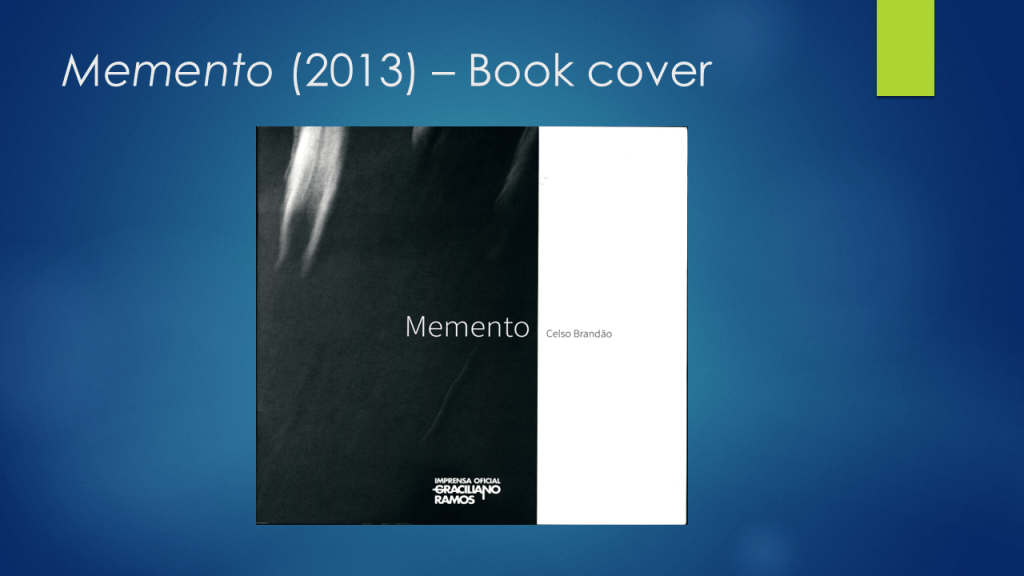
Memento, the catalog for the eponymous 2013 exhibit of CB’s photos in Maceió, includes a text by the curator, Karla Melanias which states that
A mysterious emotional component is added to the documentary quality of these images. The additional layer defines a photographic locus built between reality and imagination. Its enchantment is shown to be capable of transforming the ordinary into something from the realm of fantasy. It is more than just a matter of borrowing and saving everyday images, as if retaining the intangible was possible. It is rather an attempt to move in an artificial and transitory time-space continuum oscillating tautly between banality and polished spectacle. [from my own translation, included in the bilingual catalog]
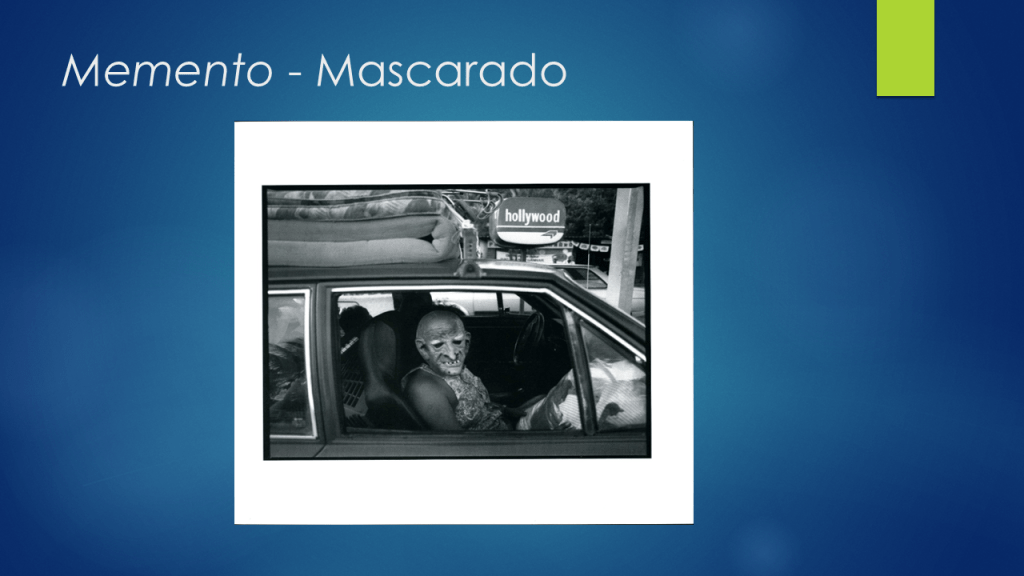
I will return to the documentary element of CB’s photos in a bit but right now I’d like to illustrate the “additional layer defining the photographic locus built between reality and imagination” as Karla Melanias puts it. If we look at this untitled photo from Memento:
PP foto Carnaval)
the masked figure accentuated by framing choices is located in a photographic locus of a driverless vehicle loaded (back seat and top of car) with things that suggest a move or a short trip during carnival, and a visual ad for a cigarette named after an overloaded term in visual culture. The figure at the center – perhaps a woman wearing a mask representing or mocking the face of an older and unattractive male whose attention has been temporarily diverted from the reality of the package in their lap so that they could face the viewer who in turn can see the instant décisif forever captured in the photo (after Cartier Bresson) but who will have to fill in (using their imagination) any and all details that would help the viewer compose a narrative which in its paradoxical present (Melanias) may wander away from the instant décisif and come to illustrate Susan Sontag’s assertion that “the camera’s rendering of reality must always hide more than it discloses.” (On Photography pag. 23)
The carnival mascarada from Memento will serve as the segue into my next section and into Caixa-preta:
Photographs of the masked face or the besmeared body are central to Celso’s documentation of popular culture.
As is well known, the motif of masking and body paint traverses historical and cultural boundaries. Masks, make-up and body paint are key to the myriad performance and performative manifestations in nearly all cultures, ranging from Greek tragedy to the kabuki, noh and butoh [check: both?] traditions of Japanese theater and dance to carnival parades in Europe and the Americas, and indigenous rituals and dances of Africa and the Americas.
The masked face and painted body motifs are placed at the intersection of psychoanalytical theory and cultural production. The former, in the impact of human impulses, phobias, the examined life, etc) and the latter in the impact of colonialism and an encroaching, grotesque capitalist model. Both, as seen in Nordestino culture, provide an angle for a more clear perception of the enmeshment of past and present, subjective and objective, factual and virtual, in that region of Brazil.
There is, in this photo, as in much of CB’s corpus, an element of humor, or perhaps a better term might be “wit” (agudeza).
The sujos, in turn, according to Roberto da Matta, are one of three kinds of blocos, the others being the blocos de enredo (ou de desfile) and the blocos de embalo (ou de empolgação). In their parade, still according to da Matta, the sujos “pedem para renascer socialmente, pois eles representam os párias, os mais baixos entre os mais baixos, os que estão no fim da linha social: aqueles cujo lugar é onde a natureza e a cultura se confundem, útero e cloaca, esgoto e porão.” Those watching the sujos parade feel threatened because of their oftten times vague age or gender, but above all, continues da Matta, they intimidate us “porque podem fazer alguma sujeira, isto é, alguma brincadeira de mau gosto, alguma piada prática ou agressiva” (Carnavais, malandros e heróis, page 99).
With their threatening fantasia, the sujos seek a place in the social order. We need to keep in mind here the etymologies of two key terms related to carnival, as it is understood in Brazil. Foliões is associated with loucura (as in A festa foi uma loucura!) and in carnival they are said to brincar – meaning, roughly, to dance or to celebrate – which comes from the Latin, vinculu, a link, a connection; in short: they are looking to fit in.
PP: Capa de Caixa-preta
The photos I will focus on from here on are from CB’s collection, Caixa-preta. For Pierre Devin, in addition to referring to the container with the instruments that register all crucial information pertaining to a flight, by dint of the color, black, it also points to “outros horizontes no campo semântico da fotografia . . . e também da demografia, da magia, da geografia, da astronomia, da física e da metafísica.” (page 126). And toward the end of his text included in the book (and quoted here in the Portuguese translation of Fernando Fiúza), Devin says that Caixa-preta, “mais que um assunto, uma história, uma narrativa, é uma interrogação sobre o fato de ser fotógrafo. Uma interrogação sobre o fato de escrever com a fotografia.” (page 129)
To situate the criticism of Celso’s visual work – in Caixa-preta and elsewhere – beyond the limiting scope of regional profiling, this presentation invites us to consider a couple of concepts that critique the restraints of a realistic documentation and move instead toward connecting his work to spaces of esthetic production, which would allow us to see that the bloco de sujos parade, for example,
1. has a clear performance site, which is the streets of a community called Fernão Velho, just outside Maceió;
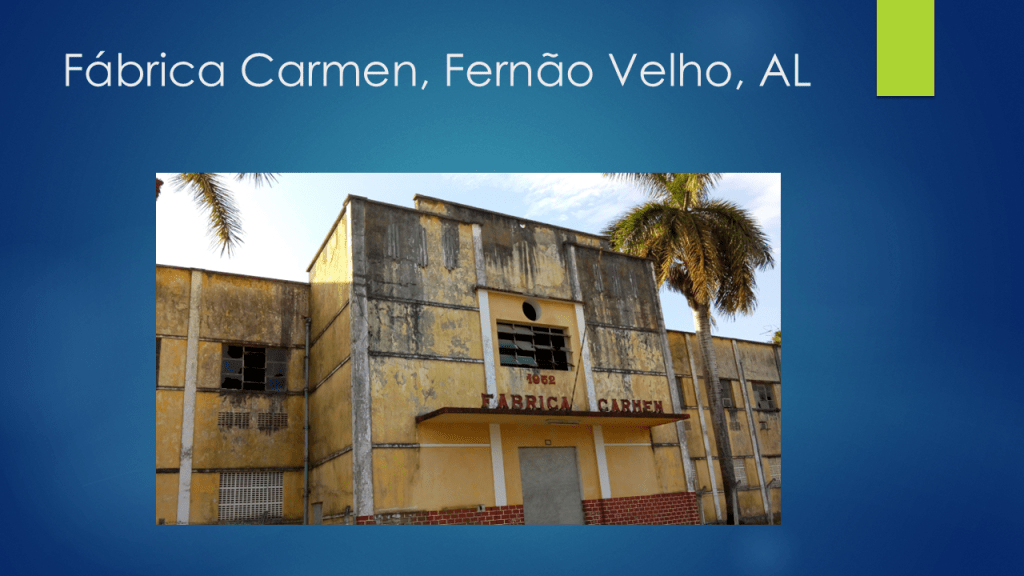
(PP: foto Fábrica Carmen, from laptop)
2. is linked to decadent economic interests such as an old textile factory in Fernão Velho
NB: Celso has a film about Fábrica Carmen called “Memória da vida do trabalho”, available on vimeo.com/estreladonorte/videos [if I write a longer version of this essay I’d like to include an examination of both visual registers of the failed factory]
and 3. suggests migration pulls, racial tensions, ethical issues and an ecological threat occasioned by the use of improperly discarded burned oil that is “made available” to the revelers and dancers who perpetuate a form of popular culture long enjoyed by an underprivileged community.
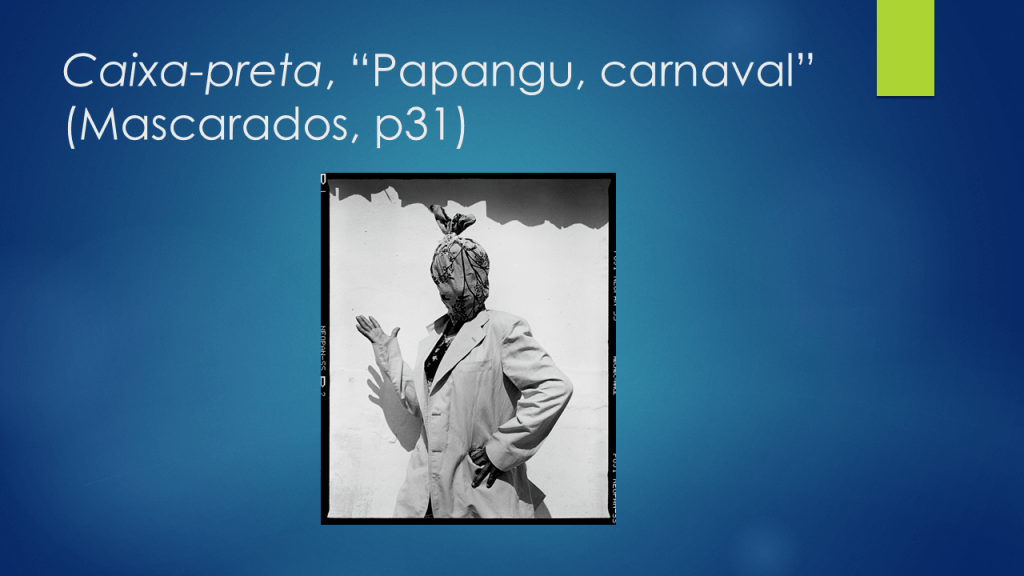
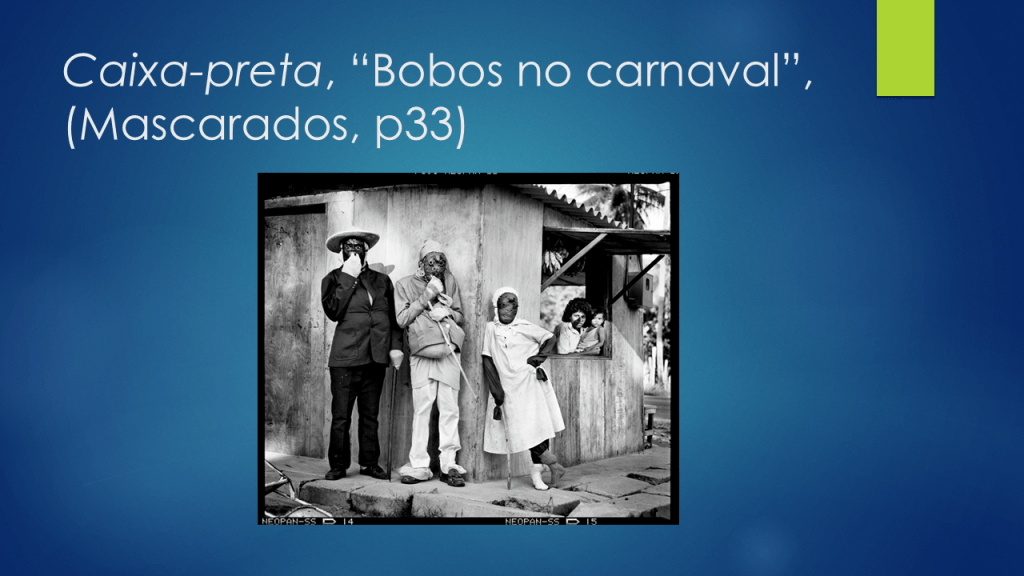
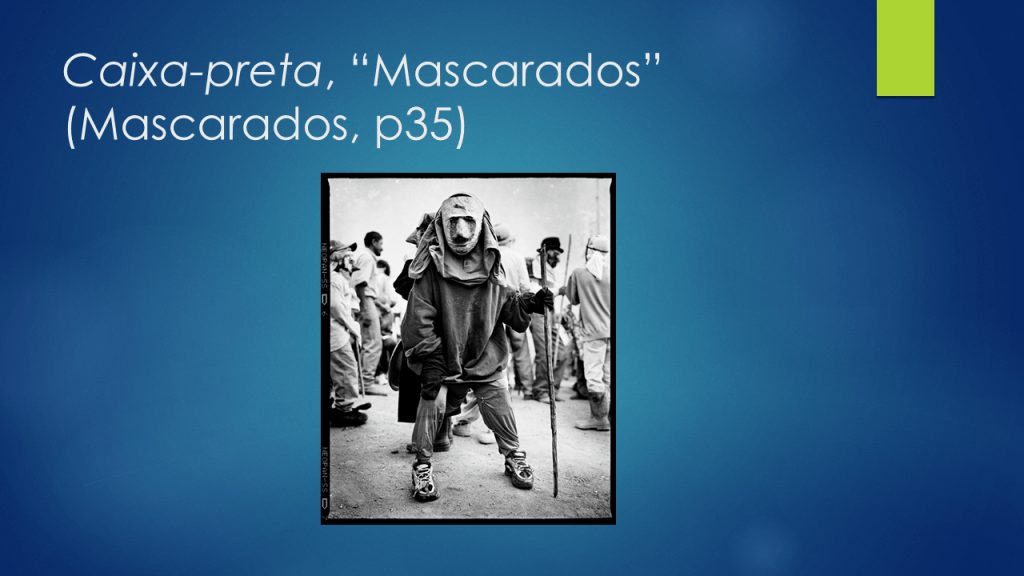
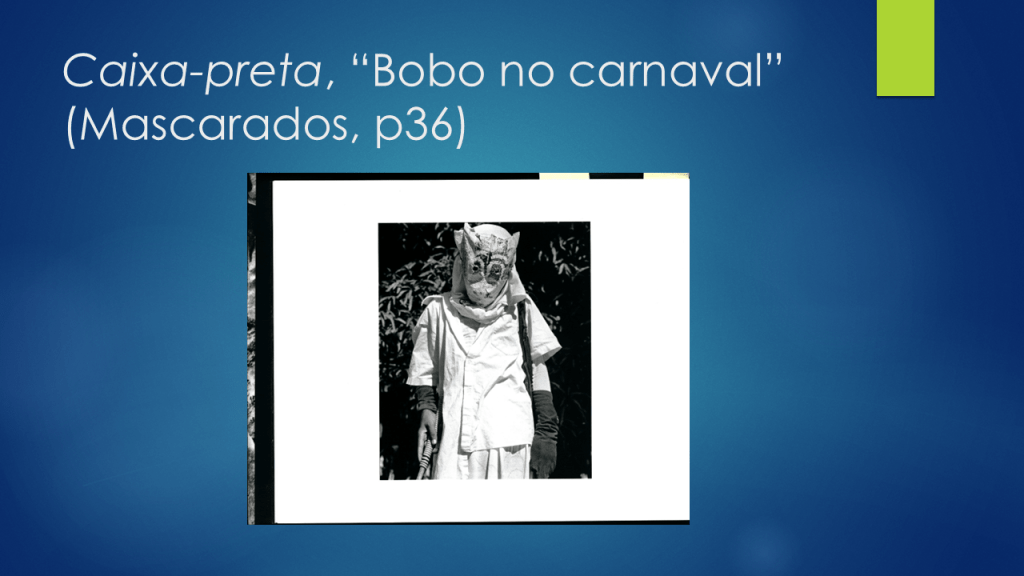
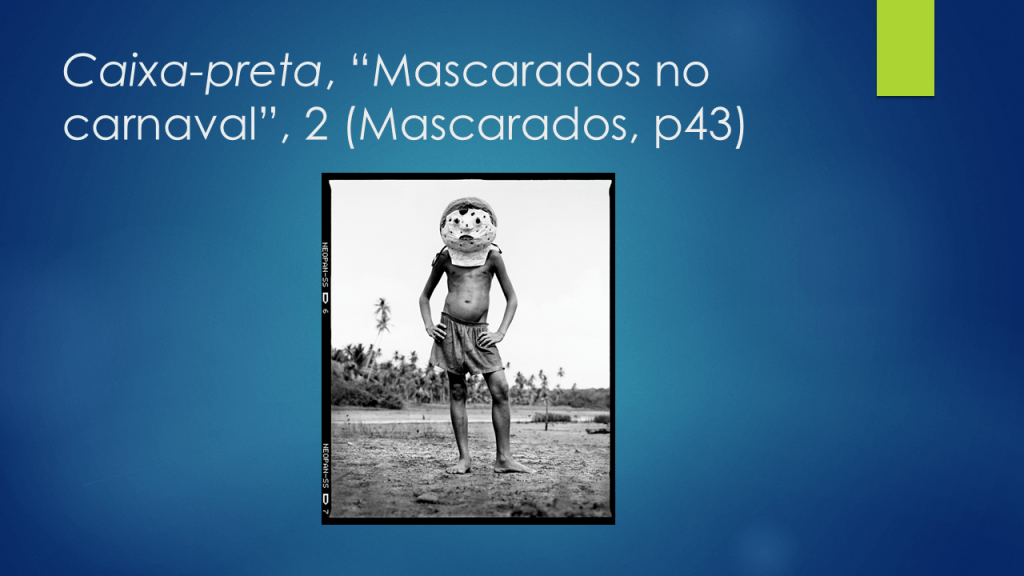
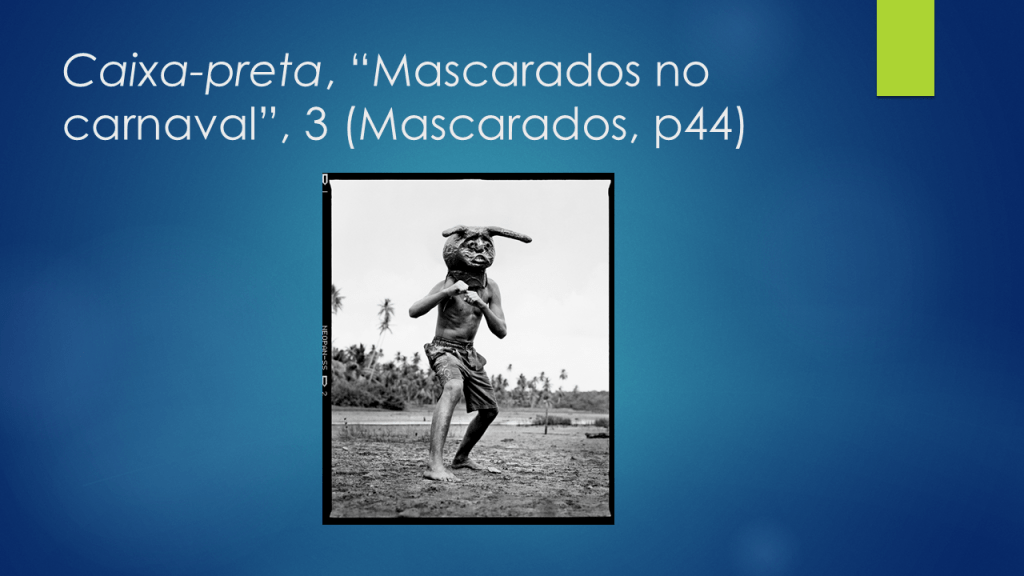
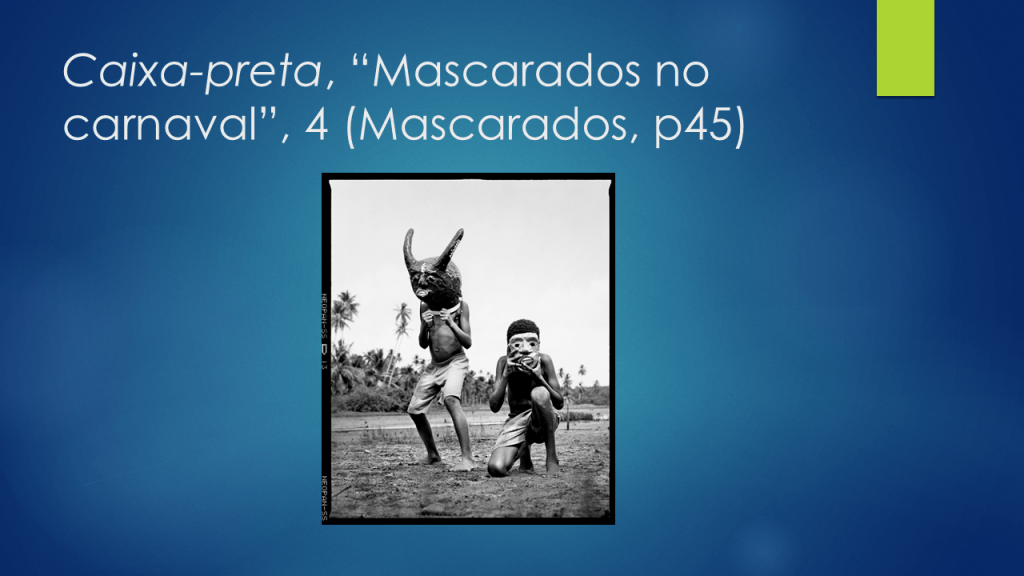
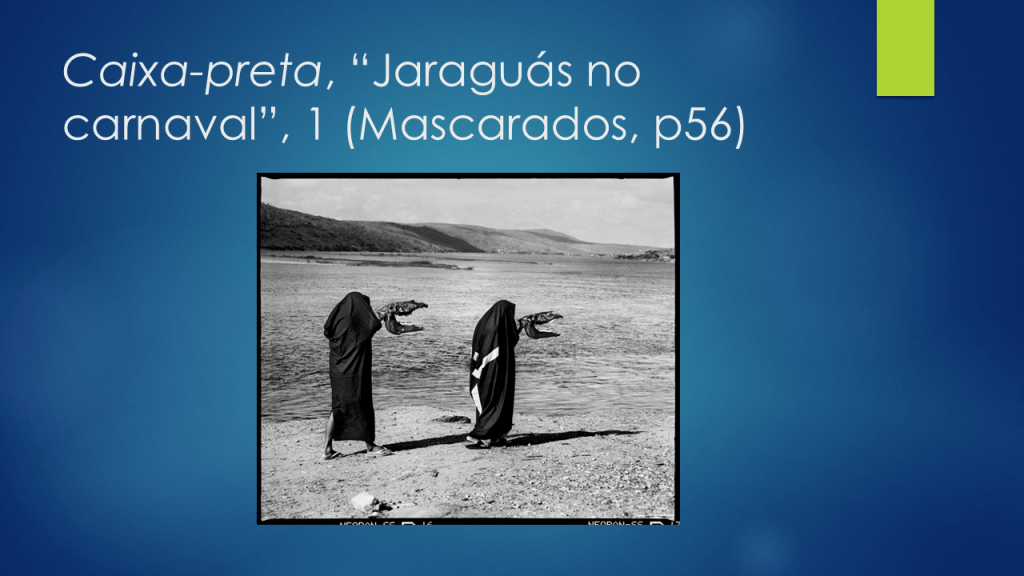
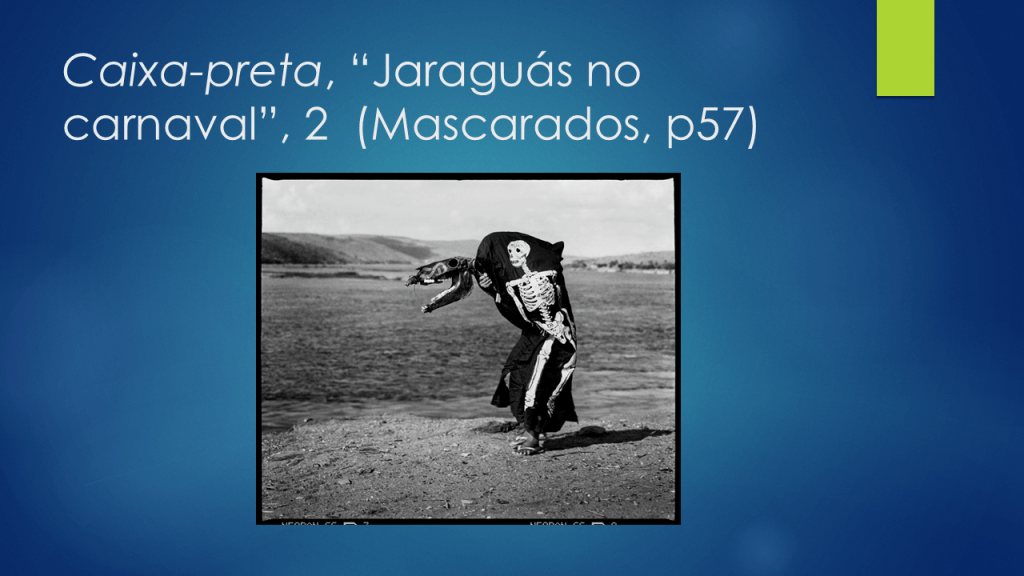
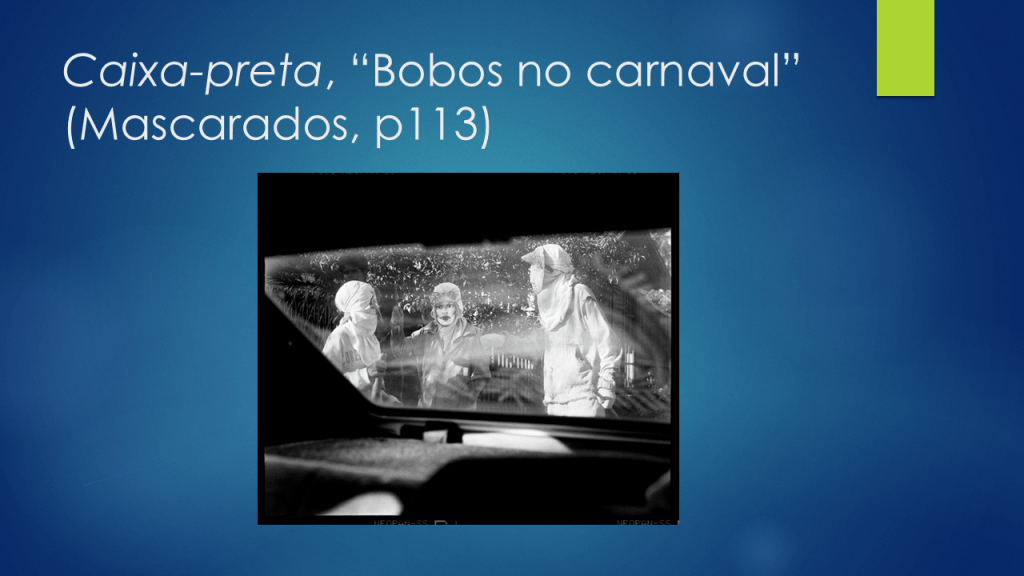
The sequences from Caixa-preta I examine next are those of mascarados (pp. 31-36, 42-45, 56-57, and 113) and especially those of sujos (pp. 39, 95-101).
The photographs of sujos in Caixa-preta document a world of seldom recorded people who lived somewhere between the ordinary and the supernatural. Smeared or covered with flour or talcum powder or a greasy or sticky substance, these men take to the streets in groups; only occasionally do you see an individual sujo parading solo. Mascarados, in turn, seem to go out by themselves more often, as in the photo from Memento we saw earlier; one of the striking things about that photo is that the absent driver at the wheel suggests absence of motion as well as other types of movement – the driver is walking or running away from the car, the driver has stopped to talk to someone, and so on.
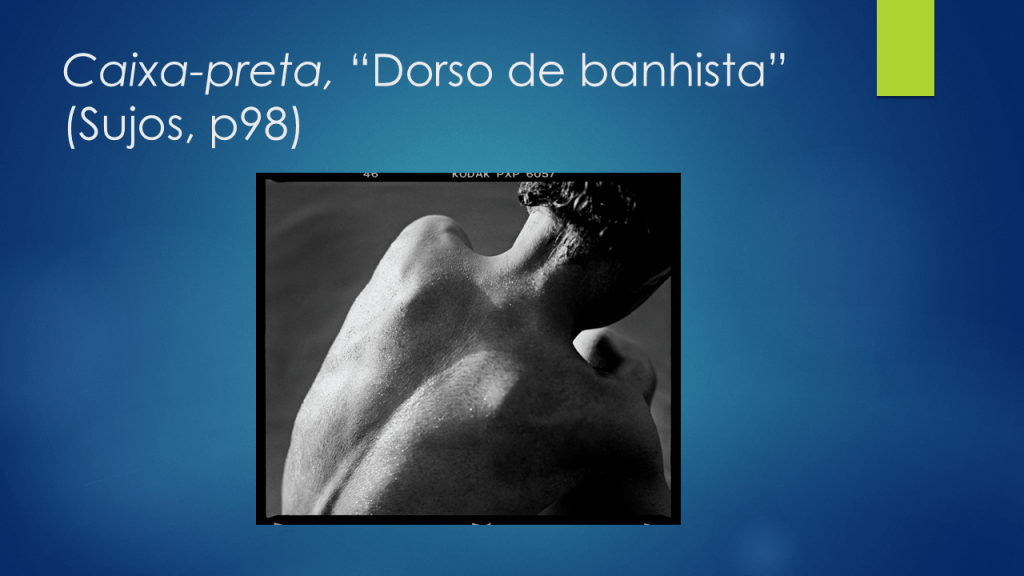
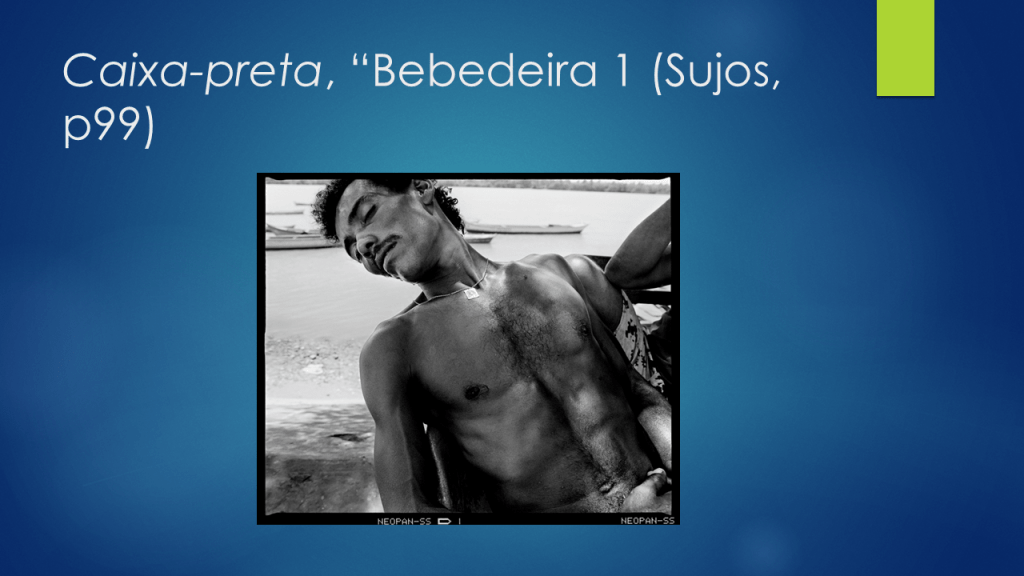
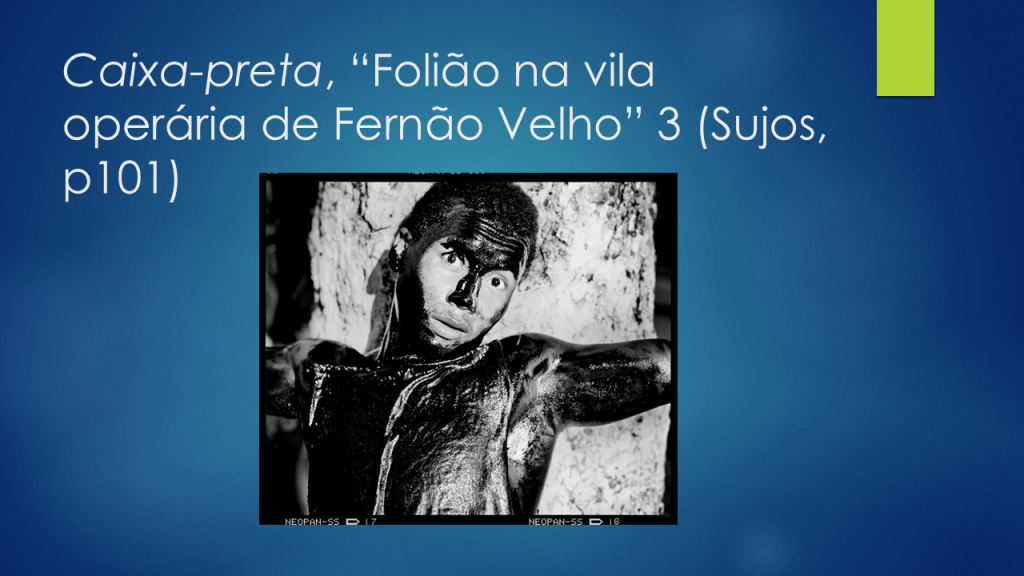
I will next concentrate on a series of six photos from Caixa-preta where the camera captures sujos not as part of a group but individually
(PP, 95-101).
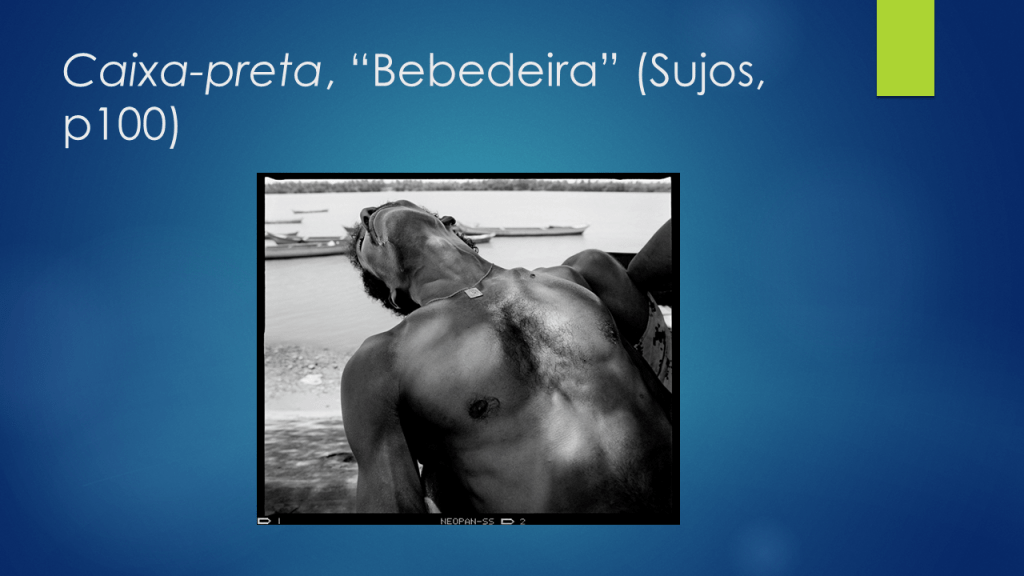
Three of the photos focus on faces and the other three on the chest or back.
Beginning with the photo on p. 95:
here the framing responds to the gaze, directing attention to the model, whose eyes seem to be the only part of his body that is not covered in burned oil. To the fixed stare of the young man the viewer responds by progressing from evasion to encounter. Here and in the subsequent photos
PP, 96-101
the two – model and viewer – not speaking, the camera speaks for them, eroticizing the reveler’s world, making desire visible in the sometimes squalid settings, without however succumbing to condescension. The youthful lines of the naked-torso models allow being consumed by the looker’s hungry eyes, except perhaps by the last one in the sequence, who looks at the viewer with a surprised, perhaps even alarmed stare.
The models’ fragile, vulnerable status as non-agent is taken by the desiring viewer as an invitation to possession. There’s no lyricism here, as actual contact is superseded by imagined, fantasized pleasure.
The fetishized, presumably heterosexual dark male body takes on an aura of bi-curiosity as if about to extend a come-on to the lingering gaze, which further complicates pleasure’s fluidity. Fragility compounded by the model’s (possibly) feigned innocence adds to the gaze’s intensity and a newly experienced sensibility to both viewer and model. The latter may also be experiencing a kind of pride for having been selected to pose for the camera, possibly for the first time in his life.
In the torso and back photos, and especially in the face close-ups where the model looks intently into the camera, CB’s choices reinforce but at times also seem to be in competition with some intricate affect such as an inquisitive coyness.
In Sontag’s thinking about photography in an image-saturated world, we would consider the above in terms of her notion that the act of taking pictures is, first, “a semblance of appropriation, a semblance of rape.”
Quoting from the paragraph where this statement is made,
The very muteness of what is, hypothetically, comprehensible in photographs is what constitutes their attraction and provocativeness. The omnipresence of photographs has an incalculable effect on our ethical sensibility. By furnishing this already crowded world with a duplicate one of images, photography makes us feel that the world [and its people?] is [are?] more available than it really is [or they really are]. (On Photography page 24]
The act of taking pictures, still according to Sontag, is also
a compulsion to photograph, to turn experience itself into a way of seeing. Ultimately having an experience becomes identical with taking a photograph of it and participating in a public event comes more and more to be equivalent to looking at it in photographed form. [page 24]
Even as we take into account that the above was written some 30 years before Photoshop became available, the centrality of some key ethical issues hold – issues such as appropriating (even raping) the thing or the person you photograph and substituting a photograph for a lived experience, inviting, in this context, an illusory and/or a masturbatory component to the act of taking a photograph or a series of photographs.
That intense eye contact I was talking about earlier is partially or totally impeded in the mascarados photographs. Which is my segue into two series of pictures of mascarados in Caixa-preta.
Here, with this hindered silent dialogue of model and viewer, perhaps, more than anywhere else, we can appreciate François Soulage’s dictum that a work, including a visual work, is anything but an answer; it is rather a statement made in the context of the relationship between photography and writing in an image-saturated world. [Entrevista no Clarín Revista Ñ, Buenos Aires, acessado 29-12-2017]
Sujos, and especially, mascarados, endow the folião with an anonymity that bothers authoritarian regimes, as was the case during the civil-military dictatorship of the 1960s and 1970s up until the expiration of the AI-5. Because they confer an alternative identity on its wearer, masks lend themselves to protest and resistance. Given the suspicion with which regimes de exceção view large number of mascarados amid a crowd occupying a public space, especially in a big city, is a reminder of how intimidating the right of free association is to those in power.
The mascarados we will see next (from Caixa-preta, pp. 31-36, 42-45, 56-57, and 113) were taken in a small city situation but may still evoke in the viewer a sense of fear or of being shaken or somehow feeling disturbed. We can also think of how some children or mentally challenged teenagers and adults sometimes react to masked people or in the presence of a clown, for example.
In both of these series, the mascarados and the sujos, CB’s photos seem to be both a part of a sequence of photos focusing on the same individual or landscape and an invitation to the viewer, encouraging them to see or imagine something farther, something beyond each frame. This could be, for example, what happened to that individual right before or right after the shoot.
I am thinking here of Iranian film director Abbas Kiarostami’s last film, titled 24 frames, 24 being the number of frames per second that when running in front of a projector create the illusion of motion. Kiarostami, who was also an accomplished photographer, wondered if reality could be captured in a single frame and so his film is composed of precisely that kind of visual speculation – what was going on just before or right after each of the 24 still photographs.
I do not want to lead you into believing that CB only works with Black and White photography. Although his most important works are in B&W, he has also made incursions into color photography, including the registers of sujos and mascarados we’ll see next. Not all of these pictures have appeared in books; some of the ones we’re looking at here are among the many he sent me over the years, and they are often untitled or undated.
Because of time constraints, I will be showing the next slides quickly.
For example,
PP here – copy from 2018 APSA Celso: sequence of Sujos – cores -1; Sujos – cores – 2; and Sujos – cores – 3.
The men in this color sequence, in all likelihood carnival revelers smeared with some kind of powder, are part of an unnamed group but photographed individually here.
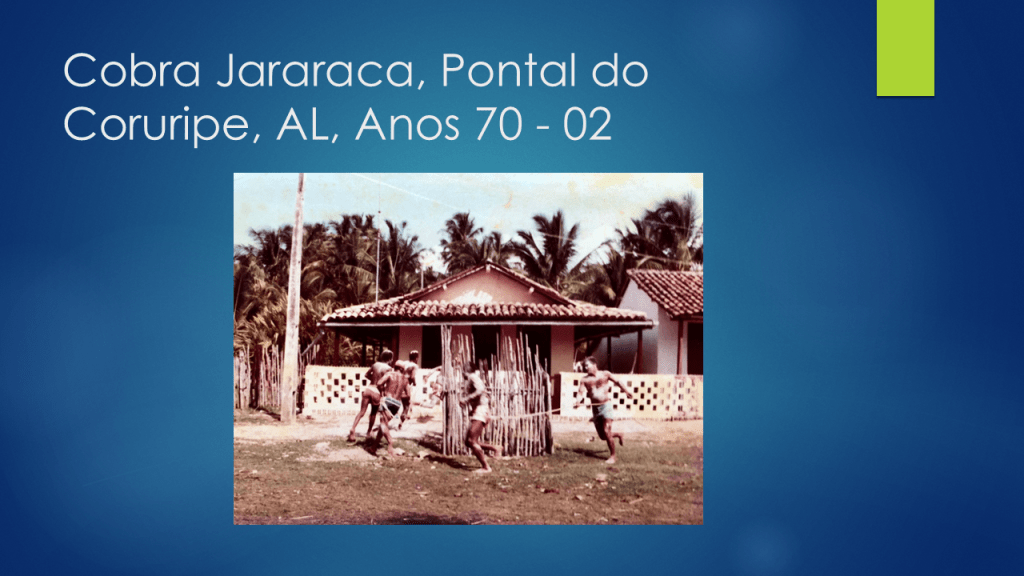
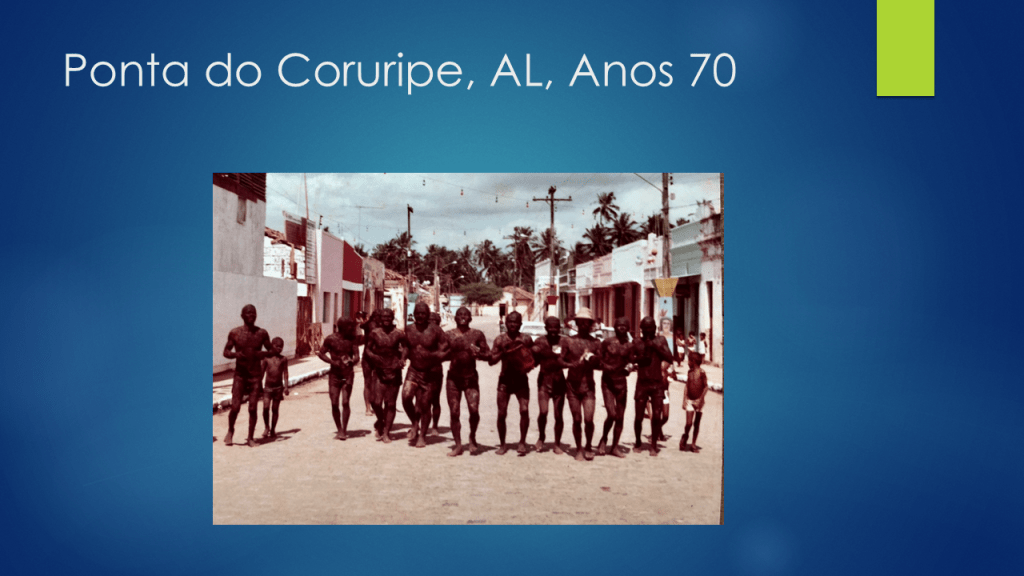
In the next sequence, also of color pictures, we see a group called Cobra Jararaca in Pontal do Coruripe, Alagoas, in the 1970s.
This bloco de sujos is made up of young fishermen who paraded down the streets of their village reciting or singing brief rhyming lines, often improvised to flatter the residents of the house they were approaching in the hope of getting a small amount of money for their next round of cachaça.
PP here – from 2018 APSA Celso – Cobra Jararaca Pontal do Coruripe.01 and 02
Here, one of the dancers, representing a snake, or perhaps THE snake (the devil) is tied up with a rope and “forced” by the others to run and dance around a fragile structure representing the place where they are trying to confine him, the serpent. Note that the smaller amount of powder or flour they use may be a possible indication of their poverty.
03 is a photo taken at same place, Pontal do Coruripe and approximate date, or at least same decade, only they are not tied up with a rope and their bodies are smeared with oil instead of powder or flour.
CB’s photos of men whose bodies are smeared in burned oil and are participating in ludic or performative popular culture manifestations offer a stark contrast to Sebastião Salgado’s well-known B&W representations of labor in his extended sequences seen in exhibits and books such as Workers: An Archeology of the Industrial Age (publ. 1993) depicting oil industry laborers in 1990s Kuwait or gold diggers in the open air mine of Serra Pelada, Brazil, the decade before.
The next photos, also in color, are of mascarados and are in keeping with the fact that mascarados – sometimes called caretas SEE PAPELZINHO – go out by themselves and not as part of a group.
This sequence we are looking at now is of Marmotas, taken at Ilha do Ferro, probably in the 2000s.
PP here – from 2018 APSA Celso – Marmota, Ilha do Ferro.01; and 02
The piece of cardboard on his head reads, “Estamos juntos para brincar e festejar o carnaval”, the “nós” being the individual, presumably a man dressed as a pregnant woman with a baby in her arms, with crossdressing and making fun of women – if not woman bashing – being part of an age-long tradition during carnival and other pre-Lent popular culture manifestations. [QUOTE THEORY HERE]
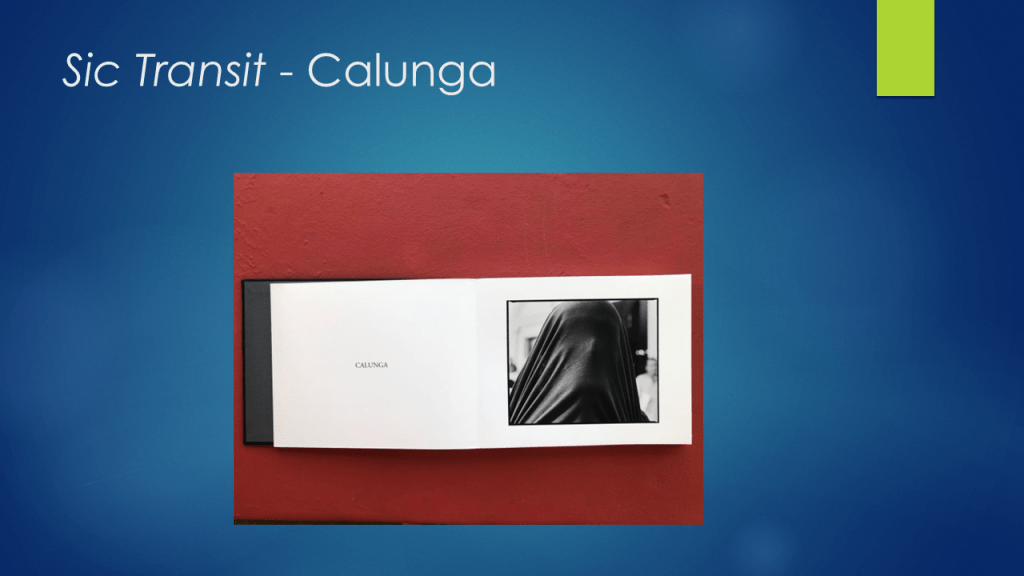
The following slides are from another of Celso’s books, Sic Transit
PP here – from 2018 APSA Celso – Sic Transit – Calunga
we see the Calunga, which is another form of covering one’s face, this time with a veil, worn typically by a man, and which can be of any color or fabric. In different areas of the Nordeste the calunga is a boneco and can also mean a puppet or a hand doll as in a mamulengo, etc. [marionetes or títeres ].
[QUOTE HERE FROM DEFINITION OF CALUNGA – GOOGLE, WIKIPEDIA, ETC]
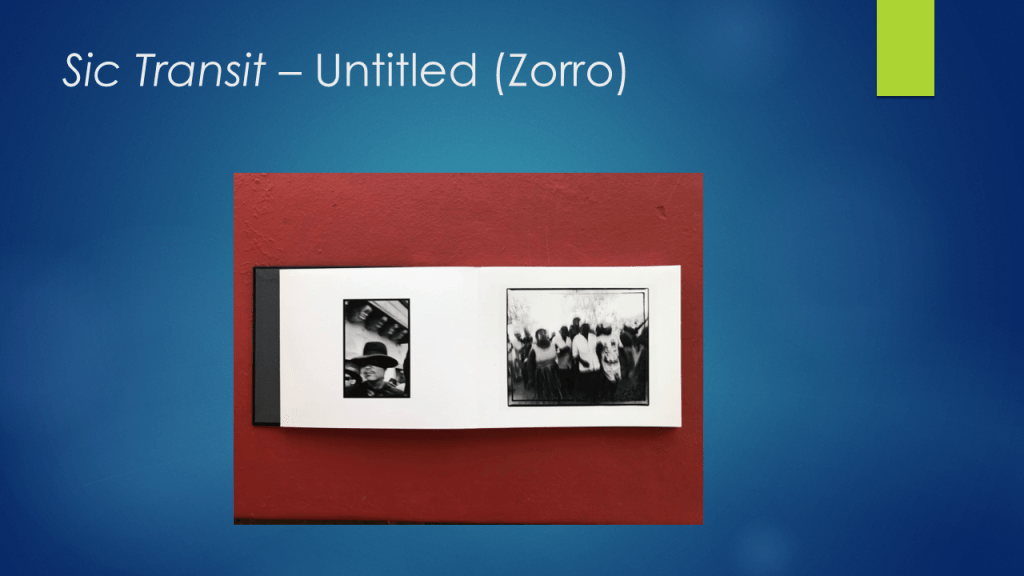
Next I will just show very quickly one last photo from Sic Transit
PP here – from 2018 APSA Celso – Sic Transit – Foto 6 (left)
which is one of CB’s best known photos, this zorro with his face partially covered not only by the trademark black mask but, in a smart touch, by the shade from the man’s hat.
These sujos and mascarados captured in Celso’s photography are part of a refutation about which Marcelo Campos writes in a text distributed at an exhibit of Celso’s works (mostly from Caixa-preta) that he curated at Galeria da Gávea in RJ earlier this year. Although not mentioned specifically by Campos, sujos and mascarados are part of the popular manifestations that rebutted 19th century art critic Gonzaga Duque’s belief that there was little chance for a relevant culture to blossom in Brazil because of its “povo acanhado, ignorante, pequenino” formando “uma sociedade vadia e beata”. As Campos states, Gonzaga Duque missed the point about the richness in the práticas dionisíacas of such beatice and vadiagem and how central they were in the formation of an understanding of Brazilian culture that came to the fore a few decades after Gonzaga Duque was writing. Those bodies, beatos e vadios, came to signify a “conquista de liberdade, presença do extra-oficial, subversão às disciplinas e normatividades.”
Theory of: [GOOGLE ETC]
Photo sequencing;
The theatricality of face photography/portraiture: SEE INTRO TO BOOK IN APSA CELSO 2018
Moving now to the conclusion, and alluding to photographer Maureen Bisilliat’s statement in relation to her pictures of Guimarães Rosa’s imagined universe, with this project I aspire to “ver com a palavra”, a palavra crítica, that which CB “escreve com a imagem”, and please, I am not trying to being on a par with G Rosa here, far from that, nem de longe.
Rather, my goal is to help publicize the photography of this very talented Nordestino visual anthropologist, who is virtually unknown in this country. Working within and around the constraints of the Brazilian social class divide while bringing to the critical fold issues of belonging, CB’s photography, while steering clear of condescension, exemplifies cultural democracy, in that works like his visual anthropology can transform our notion of what makes a photograph and why.
The discerning eye of a social anthropologist is behind Celso’s vast visual work, one that focuses on a wide array of subjects ranging from dramatic dances to carnival groups to religious manifestations. In both his films and his photos the point is consistently inclusion as, overall, his project challenges the formerly prevalent notion of the popular artist as marginalized and lacking in execution and technique.
Not represented in today’s panel is the critical study of CB’s filmic output, which is a fantastic topic for articles or a thesis or monograph. Likewise, new insights are needed into the relationship between moving images and static shots made through the lenses of the same artist, in this case, Celso Brandão. I hope that this introduction to his work might lead others to explore new directions in the study of Celso’s vast corpus of work.
In the documentation of the work of popular artisans, or in the depiction of anonymous individuals in disadvantaged areas, the core of Celso’s filmic and photographic work steers clear of cultural appropriation, with the camera, especially in his films, adopting a neutral, often stationary stand which lets the artist conduct the narrative and consequently become a subject who can often forgo commercial intermediation in the form of agents and/or brokers.
Shying away from objectifying the artisan or the case of this paper, the revelers in diverse, even threatened expressions of popular culture, the vast corpus of Brandão’s visual ethnography is above all a decades-long cultural democratization project.
———————————–
[NB: the burned oil was for the most part made available by the industry, who would thus hide under the cloak of sympathetic patrons and supporters; that practice was discontinued even before the factory closed down four decades ago; I have yet to verify the claim that what stopped it was the improved education of some community members, including the son of one of the bloco leaders who went to medical school and began alerting dancers about the toxicity of the burned oil. In recent years, dancers buy the oil from gas stations or collect it from truck stops, which could be seen as a perversion of the notion of reusing or recycling oil derived products]

